
All at Sea
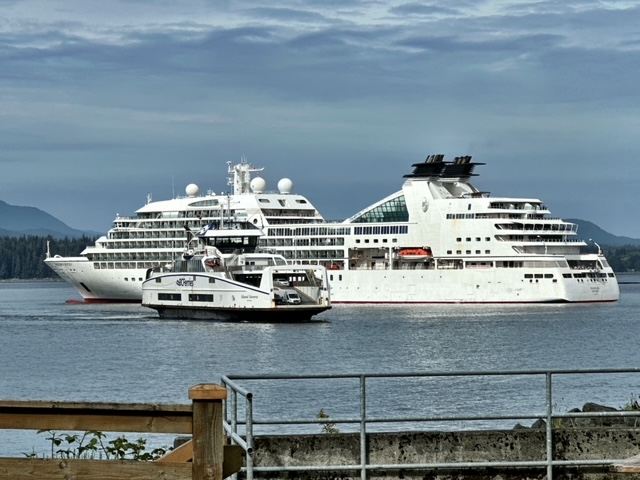
As you will have gathered from the previous post, for much of this year so far Sandi and I have had the great fortune to travel with the Seabourn cruise line where I deliver on-board “Conversations” that help guests understand the new cultures in which they find themselves. First came back to back cruises Hong Kong to Singapore then Singapore return through Southeast Asia. That previous post covered the next voyage from Darwin up to Taipei after which we spent three weeks in Japan before completing the most recent one, Kobe across to Vancouver via the Aleutians and Alaska.
Having reached Japan we spent time in one of the older parts Tokyo, around the traditional shopping precinct in Yanaka that also happened to be close to the Nippori fabric district. It is amazing to be in one of the world’s largest cities yet still feel relaxed and able to move about, even during blossom season (apart from boom areas like Akihabara). One highlight was meeting Ash Warren, an Australian long resident in Tokyo and author of a marvellous book on sumo, the national sport and among the world’s oldest professional ones.

Then came Kyoto and the Philosopher’s Path as well as some marvellous netsuke and fabric museums, and the start of our search for the best okonomiyaki. Somewhat loosely described as Japan’s pancake dish it is really a marvellous fast food creation with fresh vegetables, bacon, egg, sauce and pancake-like mix, all finalised through dextrous spatula work on a hot plate with the performance as important as the final product.

Okayama was next, a lovely city famous for the Korakuen gardens which are splendid at any time let alone the cherry blossom one. The canal walk gardens at night are also a delight, but the real highlight was a bike ride in the country. We travelled by local train to a remote stop which hosts a bike hire shop, then set off on a twenty kilometre ride through villages, paddy fields, temples, parklands and other historic sites before turning in the bikes at another location then catching another train back into Okayama.
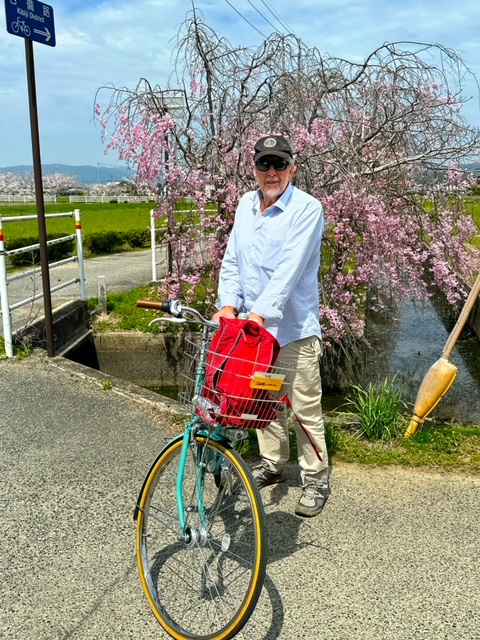
Seeing big family picnics along the way was further reminder that all over the world, some priorities are held in common. The hotel, its excellent in-house onsen (hot spring centre) and all the rituals that go with its use, though, also remind us that some things remain country specific.
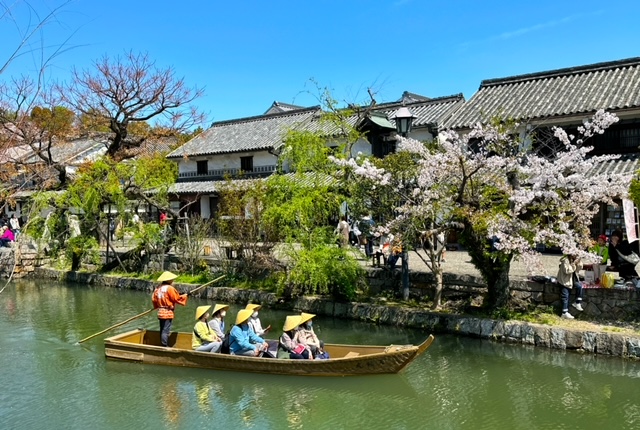
A short shift saw us in Kurashiki which at its heart has preserved some of the old canal district, reworking it as a tourist centre with traditional houses, museums, teahouses and restaurants, art galleries and gardens. It works, even if the straw hatted tourists being boated up the canal look a bit kitsch. The area emerged as a commercial and production centre during the later nineteenth century Meiji modernisation process, when the West was seen as an exemplar. So successful factory owners did things like buy Monet, Manet, Matisse and the like which are still to be seen there.
Food, of course, is a mania in Japan, Tokyo being the city with the most Michelin-starred restaurants anywhere in the world. So it wasn’t really a surprise when we found an outstanding pizza place two hundred metres from our hotel the night we arrived in Kurashiki looking for an easy meal. The owner had spent a lot of time training in Italy so the product was perfect, better than anything we find back home. Red and white checked tablecloths and Peroni completed the sensation.
And a couple of hundred meters along from there, we later discovered a really good okonomiyaki place where the owner also made exquisite wooden puzzles in his spare time, including elaborate ones of sumo wrestlers.

After all that, Kobe under reconstruction was confronting but some of the shrines and their gardens provided an escape, while the extensive shopping arcades yielded all sorts of quirky enterprises. There is something left of the old and famous foreign legation centres but much of it is total tourist, like the house that now commemorates Sherlock Holmes.
Joining Odyssey in Kobe was like returning home. Having travelled on the ship before we knew many of the crew already, and some guests as it turned out. We left port and headed northeast, the first few stops again highlighting just how different Japan’s regions can be. Places like Sendai, Hakodate and Kushiro in many ways demonstrate the challenges the country now faces: a slowing productivity rate, an ageing population and declining birthrate with all those conditions contributing to a growing social services call on the national budget which has many analysts concerned.
So it is wonderful to see local and skilled traditional crafts still surviving, along with the markets and community centres that have driven those communities over centuries. A local train trip to Matsushima from Sendai allowed a visit to the main shrine there, well over a thousand years old and a peaceful reminder that Asia generally and Japan particularly have cultural depth and complexity sometimes overlooked.
After Japan, though, came the hallmark of repositioning voyages, a string of six days at sea riding the Kushiro Current on which, my great friend and colleague Commodore Rupert Wallace reminded us, Spain’s Manila galleons also sailed across to Acapulco four hundred years ago. The modern world, then, stills works on the foundations of earlier ones despite technological improvement.
During those six days, weather and seas alike remained remarkably benign while growing steadily colder. That meant packed days of activity for guests including a range of Conversations, trivia contests, bridge lessons, craft and art, future travel planning, entertainment and, of course, food. And through those days there is also the opportunity to meet an even wider range of people aboard and, as always on Seabourn, there is a fascinating array of those drawn from the USA, Australia, Canada, the UK, several from different Asian locations, New Zealand, Europe – and one originally from Barbados with whom the chat was immediately about cricket.
The first stop after those six days was Dutch Harbour in the Aleutian Island chain with its striking mix of Russian, Indigenous and American traits. Russia and the USA are geographically close up there so the area bears the marks of conflicts past. These days Dutch Harbour is best known as the winter home of the crab fishing fleet made famous by long running reality television show, Deadliest Catch. Remarkably, the small place wears the show lightly – we had to ask to make a trip detour to the harbour moorings where the boats normally tie up as they bring in their (hopefully) million dollars plus catches following all sorts of adventures at sea during winter. This time, Northwestern was there, the only vessel to feature in all twenty or so seasons of the show, and captained principally by Sig Hansen.
As the excellent Museum of the Aleutians records, Dutch Harbour is very much a product of its past, and has a curious link to Australia. During Captain Cook’s 1778 third Pacific voyage his artist, John Webber, sketched a “Woman on Unalaska” whose personality attracted the interlopers. Over the years that sketch turned up in Sydney where it stayed until 2001 when bought by the Museum of the Aleutians. Fittingly, its subject now looks out at us from a wall no more than ten miles from where she was drawn originally.
As we left Dutch Harbour we had, for a while, an additional guest, a Bald Eagle who settled in briefly while we all marvelled at the sheer numbers of sea otters, and the the pod of whales searching for food near the shore.
At Kodiak, the next stop, one great attraction was Big Ray’s Outfitters complete with a massive taxidermied grizzly bear and a full range of weapons alongside the clothes. One assistant was an instant guide to Alaska’s focus on hunting, shooting and fishing even if conservation is now prominent. Recently relocated from Montana, he was ticking off some bucket list hunting items. For many guests, the other big attraction was a trip to Walmart!

A run further up to Homer revealed a marvellous bookshop run by a woman who had spent considerable time in New Zealand; a magnificent Burmese Mountain dog; a legal cannabis outlet (for observation only), and a set of wonderful people. And Time Bandit of Deadliest Catch was in port so the focus of much attention.

Then came the magnificence of Glacier Bay on a clear day, followed by Sitka and its long running raptor rescue centre which houses and retrains some magnificent birds. As elsewhere in the Aleutians and Alaska, there is also a reminder of just how close Russia is and how long standing the connection has been. The Matyroshka dolls are everywhere.
Next, a voyage highlight. Odyssey became the first cruise ship ever to stop in at the communities of Klawock and Craig on Prince of Wales Island where the whole community, largely of First Nations origin, turned out in support. They have run a campaign in recent years and constructed a deep water dock to attract the ships, calculating that controlled visits will yield local benefit. They had excellent crafts on display along a huge amount of goodwill. The communities rely mainly on logging and fishing, so a tourism strand is considered a good addition.
The Seabourn guests loved it, mainly because of the people they met, as did we. Lawrence, for example, is a former mayor who visited Australia and New Zealand, including Fremantle, while serving in the US Navy, and now makes a living from his jewellery inspired by First nations traditions. One of the bus drivers served in the marines, and numbers of other people had returned to the community after being “away,” some for several years.
For many guests, the fish chowder served up at the tribal community centre was the best food they had anywhere off the ship.
Then came a complete switch, one with a complex hook.
Ketchikan, the next stop, was a total contrast. We arrived there along with two other large cruise ships so that a vast number of passengers hit town early in the season. That will be the norm for the next few months, the town openly a tourist destination. Back in Craig, one crafts store owner suggested we visit just one specific Ketchikan outlet, the only independent one left – and it was excellent, with a resident First Nations artifact painter.
The one remaining fur shop and its high prices were reminders of the trapping trade that spurred the growth of the town and other northern Canadian ones like it in the first place. For the most part, though, the big stores sold much the same thing and at similar prices so that, to quote a once famous Australian sports commentator, it was a bit deja vu all over again. For anyone in search of a king crab meal, $US90 and upwards seemed to be the norm.
Somewhere between the extremes of Ketchikan and Craig, of course, lies the balance point for the growth of tourism – rather like our current hometown of Fremantle’s challenge in balancing the influx of food and alcohol outlets against organic community development.
Elsewhere in the world, places like Venice, Amsterdam and Barcelona have decided they are now past that point and need to rebalance, sometimes to the chagrin of visitors like those to Venice now to paying a daily fee. Ketchikan shows no signs of any such levy, and Craig has invested heavily to get people there. And in its present state, it is well worth visiting. But what will it look like a few years on?
From Ketchikan we cruised down the British Columbia coast, on watch for whales and other wildlife before a stop at Nanaimo and the sail into Vancouver. Later that evening, having dinner with friends near the University of British Columbia, we watched Odyssey cruise back out and, at that point, we thought it the likely last time we saw her as a Seabourn ship – come September and after the Alaska run season, she will sail back to Japan and become part of the Mitsui empire under a deal done last year.
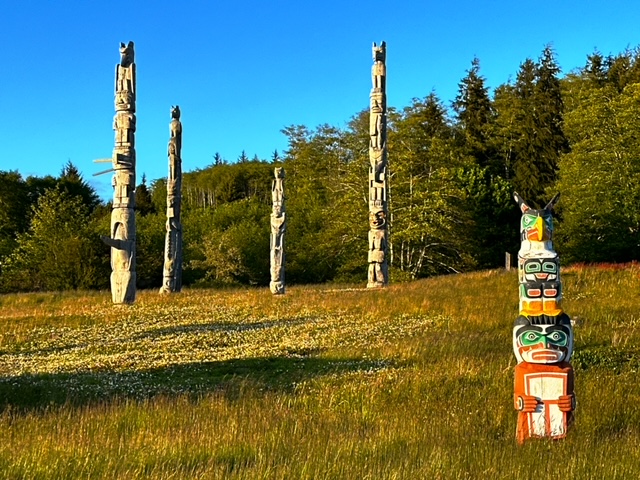
For the next several days we were on Vancouver Island, one of our favourite places, looking for wildlife and taking in the splendid landscapes. Our last stop was Alert Bay on Cormorant Island, a short ferry trip from Port McNeil. It is a largely First Nations settlement and the U’Mista Cultural Centre there is an outstanding museum that records the tough history of European settlement and dispossession, the industrial schools that separated kids from their families, and the hard battle for indigenous recognition and restitution.
Alert Bay is quirky, but replete with eagles, sea otters and Orca, a wonderful retreat. On the morning we left to begin the long trek home, a lot of Zodiacs were zipping up and back along the water, full of suited up passengers. One of our hosts suggested there might be a cruise ship at anchor. We packed up and headed the car for the ferry to discover that she was right, there was a cruise ship in the Bay – Seabourn Odyssey.
So at the very end of our extensive travels we sailed past “ODY” aboard the car ferry, all set for very different destinations.

 Brian Stoddart
Well written my friend and enjoyably read! Living the dream!!
LikeLike
Thanks a lot as ever Clint and hope all going well
LikeLike
Thanks for sharing your trip of a lifetime through your photos and commentary. We had a great time watching.
LikeLike
Thanks a lot my friend, we will catch up soon!
LikeLike