
At least seven cruise ships are now off the Western Australian coast, retreating to who-knows-where as their future remains unclear following the COVID-19 carnage that has unfolded around them here and elsewhere around the world. WA premier Mark McGowan has maintained his hostility towards them with a “don’t bother stopping” message. https://www.watoday.com.au/national/western-australia/keep-on-going-premier-s-blunt-message-for-cruise-ships-rounding-wa-coast-20200409-p54ipg.html
For a good sense of what it is like aboard these ships, Captain Jonathan Mercer’s Amsterdam blog is excellent. The ship left Fremantle, crossed the Indian Ocean to Durban, disembarked South African crew there – then set off back across the Indian Ocean to Batam in Indonesia (just by Singapore) where more crew will leave. He now considers the Amsterdam as a “leper” ship, a sad thing for any Captain but especially so for him on his very last voyage. http://captainjonathan.com/10th-april-2/

There is one great human story amidst all this. A couple of posts or so ago I mentioned that the Magnifica had been here in Fremantle a few weeks ago but not allowed to land. It, too, set off across the Indian Ocean only to find a host of ports closing up. It originally was to land in Colombo in Sri Lanka but a ban appeared there, too. A Sri Lankan junior chef videoed a message to the President of the country and, lo and behold, as the ship passed Galle an armed forces vessel arrived to take said chef home. https://www.newsroom.co.nz/2020/04/12/1124937/any-port-in-a-coronavirus-storm
The rest of the passengers and crew are, no doubt, hoping to find a similarly sympathetic ear somewhere else. I suspect a lot of videos are also being made.
Back in Australia, meanwhile, deaths among Ruby Princess passengers have reached at least seventeen, and positive VOVID-19 tests have now been recorded among North Americans who were on the ship. Authorities think there may be as many as nine hundred of them with just a fraction tested. https://www.abc.net.au/news/2020-04-13/coronavirus-concerns-for-international-ruby-princess-passengers/12143544
So the international cruise industry remains under extreme pressure (with class actions mounting), with company and peak body leaders struggling to maintain momentum. But if it is any consolation, they are not alone.

These on-going virus developments trace the impact being felt in unsuspected quarters, and one such has just appeared in a New York Times report about the collapse of the Dutch tulip market. Almost 150 million of them have been crushed as demand disappears because flower shops around the globe close in the face of cancelled celebrations. International Women’s Day, for example, is a huge day for flowers, but not this year.
The Dutch industry is worth around $US7 billion a year so many jobs have been lost and the future looks grim. https://www.statista.com/statistics/581482/value-of-the-import-and-export-of-tulip-bulbs-in-the-netherlands/
And one major supplier saw a direct cruise-related problem: a big client is Viking River Cruises who will have no American passengers this season, and that was worth about a million Euros. https://www.nytimes.com/2020/04/12/world/europe/netherlands-tulips-coronavirus.html?referringSource=articleShare

Interestingly, the industry was already facing a challenge. The world-famous “floating” tulip market in Amsterdam had been accused of scamming tourists: bulbs did not bloom, fewer bulbs than advertised were in packets and reactions were poor. The cruise effect was again present – as Amsterdam banned the ships, numbers at the market were in decline anyway. https://www.theguardian.com/world/2019/oct/15/amsterdam-tourists-tulip-scam

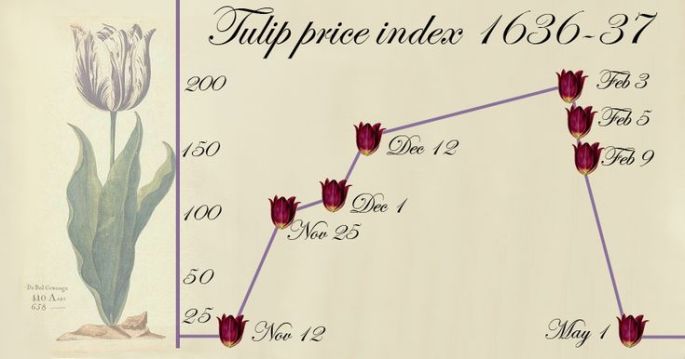
This is calamitous but not catastrophic as it was almost four hundred years ago in 1637 when the Amsterdam tulip price endured what was in many respects the world’s first future market collapse.
Tulips originated really in Persia, as it was, and reached Amsterdam via Vienna from Constantinople (Istanbul) in 1554, courtesy of Ogier Ghiselin de Busbecq, the illegitimate son of an aristocrat on the Franco-Belgian border. He was the Holy Roman Empire’s Ambassador to the Ottoman Empire, but also a trained botanist who had studied at the University of Leuven and several Italian ones.

Tulips became like the spices of the East Indies (Indonesia), much sought after in Europe with status and custom driving up the price. The Dutch discovered that their conditions were ideal for tulips, and experimentation mixed with market demand to produce new colours and styles, and escalated prices. By the time the mania peaked a single bulb might change hands in exchange for several acres of land, or for ten times the annual wage earned by a skilled artisan. It was true market mania driven as well by demand from the French, and it came to shuddering collapse in February 1637.
And there is a virus connection. The collapse started in Haarlem where no one turned up to an auction – as more or less has happened now – and that was partly due to a local outbreak of the bubonic plague. https://www.investopedia.com/terms/d/dutch_tulip_bulb_market_bubble.asp

The present Dutch collapse has been matched elsewhere. In India, for example, the lockdown has smashed the sale of flowers for weddings and for Hindu rituals. Anyone who has been near a Hindu temple will know they are surrounded by flower sellers, with the making of garlands a major industry. That has all gone and growers around the country are dumping millions of blooms to become part of the emerging economic problems now faced by Narendra Modi’s government. https://www.businessinsider.in/business/news/farmers-destroy-millions-of-flowers-for-lack-of-demand/articleshow/74914792.cms
And the problem has extended to the far-flung reaches of New Zealand where entrepreneurial horticulturalists have also run into problems. In Southland, for example, one farming family grew and exported bulbs as an alternative to the traditional sheep, cattle and dairy enterprises. They are now hit both by the falling global demand and the rising domestic New Zealand quarantine requirements brought on by the battle against COVID-19. https://www.stuff.co.nz/business/120704172/coronavirus-no-export-for-150-million-tulip-bulbs

Smaller businesses have been hit in New Zealand, too, with lily growers facing the loss of an annual income. https://www.tvnz.co.nz/one-news/new-zealand/mowing-over-40k-worth-lillies-non-essential- flower-business-says-future-bleak This has been just the latest aggravation for a New Zealand industry that has fallen steadily over the past ten years. https://www.stuff.co.nz/business/farming/opinion/97268072/brad-markham-the-growing-problem-with-new-zealands-floriculture-industry It’s future growth will likely be stunted significantly. https://www.statista.com/statistics/1008454/new-zealand-flower-plant-seed-export-value/
These knock-on effects of the virus keep emerging, and that alone should caution against any imagined immediate return to “normal”. The idea of normal will be much challenged in the times directly ahead of us.
 Brian Stoddart